- DEN Enews
- Posts
- DEN Enews
DEN Enews
Shoulder to Shoulder Today at Noon

Diocesan Environment Network
March 03, 2026

Global news has been horrendous and heartbreaking. We can apply the same words to the provincial budget cuts. We risk losing the very essence of our Nova Scotia Nature - trees, biodiversity, wildlife and the staff who work to maintain it - not to mention the threat to freshwater and the communities it supports if extractions occur. Add to that the losses to our culture - music, literature, arts. Stand today Shoulder to Shoulder at noon in front of the legislature to share your voice of concern. Here are some images to tell you more from the Ecology Action Centre:




A good article to read:

A good video on this link to watch:


The above image accompanies an excellent post by Celes Devar on our DEN Facebook page. You are urged to read it.
Save our Old Forests has this inspirational message for you: By writing a letter to a government representative, like an MLA or Minister, to advocate for a protected area, you are engaging with a critically important process – the democratic process. Democracy is a process designed to be engaged with, and it can remain strong only when the civic population maintains engagement. Without a civically/democratically engaged population, our government systems fail to function as they were designed. No matter what position the government takes or what colour it wears, each government representative is paid to represent the people of their constituency, no matter who the people voted for (speaking of… ALWAYS make sure you use your vote and use it for what YOU believe in).
Can’t attend the rally? Flood your MLA’s office with calls, letters and emails. Find them here: https://nslegislature.ca/members/profiles/contact
Save Our Old Forests has produced a Letter Writing Kit that you may find useful: https://drive.google.com/drive/folders/1PDRypOCQDfP8KNNg4SgFG3AvaDsUwoDc
From their newsletter: This toolkit aids us in engaging the public in helping to protect old forests in alignment with the Government of Nova Scotia’s commitment to protect 20% of Nova Scotia’s lands and waters by 2030; and raising awareness about the ecological importance of protecting forests, particularly those that are over 80 years old.
Upset about cuts to Arts & Culture? A second rally is planned for Wed, March 4th.

Next week on March 9th, the Ingram River Wilderness area needs your support:
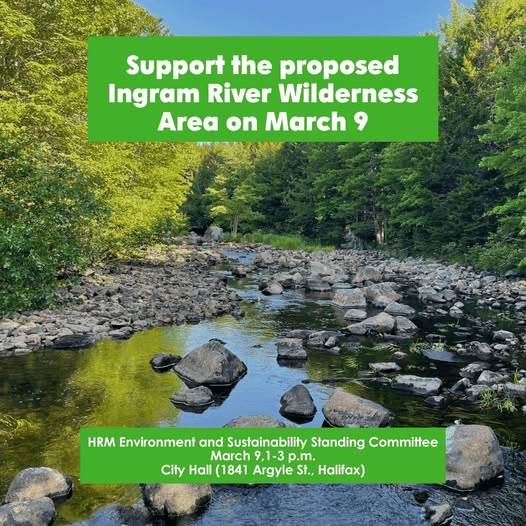
Help support the proposed Ingram River Wilderness Area on March 9!
Members of the Ingram Action Group, the St. Margaret's Bay Stewardship Association, Nature Nova Scotia and Mi'kmaq land & water protectors will be presenting at the public meeting of the HRM Environment and Sustainability Standing Committee on March 9, from 1-3 pm at City Hall (1841 Argyle St., Halifax).
Our friends advocating for the proposed Ingram River Wilderness Area would love it if folks could attend for moral support!
Find more information about the Ingram River Wilderness Area: protecttheingram.com/

And now for some much needed good news. This is from Facebook page of the Cathedral Church of All Saints:
IT’S NOT EASY BEING GREEN… so sang Kermit the Frog. It’s definitely easier being “green” when we’re intentional about it. We are forming a Green Team to oversee the Cathedral’s environmental response, to help set priorities in how we can best support our planet and address the challenges of climate change. If you would like to be part of this new initiative, please speak with Rev. Kate or message her.
Does your Parish have a green team? tell us what you have been doing to make your part of this world a little better.
To all Women out there working to save this incredible world - Happy International Women’s day on March 8th:


with thanks to Claudia Zinck
Storm Days
All of us hear that a storm is coming and prepare the best we can. What I do to get ready may not be what you do, and that’s the whole point. Walk with me through storm prep and a storm day, and then tell me what you do differently. Drop Grandma a line at [email protected]. I’d truly love to hear.
The night before a storm always feels a bit rushed. This one isn’t due until mid-morning, so most of the cooking can wait until tomorrow.
Kettles are filled. Everything that can be charged is charged. The battery supply is checked, something Grandma keeps an eye on at all times.
The generator has been tested and is ready to go. Gasoline is in the closest shed. Indoor power units are fully topped up. There’s some wood in the basement, but if the wind is high, Grandma skips the wood fire. Cozy should not mean risky.
Morning starts with eggs. Six or eight go into a pot, boiled, cooled, peeled, and tucked into a glass jar in the fridge. That’s breakfast for days. Egg sandwiches make easy meals, or you can chop them into a corn salad to bump up the nutrition without much effort.
Next comes chicken noodle soup, the dry kind you add water to and boil. It fills a thermos that stays hot for up to 24 hours, which feels like a small miracle on a storm day.
Then potatoes are peeled and boiled. With a secondary cooking unit, they turn into pan-fried potatoes or a potato hash with wieners, bologna, or whatever meat is lurking in the fridge. Boil a carrot or two and suddenly meals stretch further.
I check the bread situation: wraps, ciabatta buns, older loaves. Anything truly stale becomes bread pudding. A few slices may head outside to help the birds through the storm, sharing is still sharing.
Sandwiches are next. Some are grilled in a pan or sandwich maker; others stay cold. Storms lower our energy and having food ready helps keep anxiety down and bellies full. Mayonnaise behaves just fine at room temperature for about eight hours. I keep sandwiches in the fridge until the power goes out, then move them to the counter.
Yes, I sometimes make pizzas, quiche, or stew. This storm, though, I wanted something new, something that would warm the house a bit before the weather rolled in. Anything cooked in a slow cooker stays hot, or at least warm, for hours. Toss something together early, and supper quietly takes care of itself.
A pot of rice goes on next. Rice is handy for meals, but Grandma is really thinking rice pudding. It can bake in the oven alongside a pan of cookies or a cake. Storm days require sweets.
Plain biscuits are also a must. Add a spoonful of jam and a cup of something hot, and life feels pretty good, even when the wind is howling.
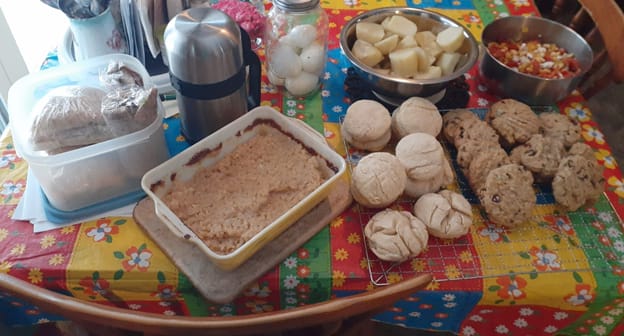
Picture this: a container of sandwiches—buns and wraps—alongside a thermos of chicken noodle soup, boiled eggs, boiled potatoes, corn salad, and front left, the stars of the show: rice pudding, tea biscuits, and cranberry and mint-chip cookies. That lineup will keep us going for quite a while.
Dressing warmly matters. Storm days start with thermal leggings and a long-sleeved T-shirt. Fleece-lined jeans or shirts keep the chill at bay, and you can always peel off a layer if you get too warm. Grandma plans for comfort, not fashion.
Once all the prep is done, it’s time to enjoy the day. If the power stays on, a good movie is just right. If not, the games come out. Nana and I love Jenga, Snakes and Ladders, or a quick round of air hockey. There’s also a jigsaw puzzle we’ve been meaning to start since Christmas, and then the card games: crib, rummy, auction, and 45s, each with its own dramatic pause before the win.
If you have portable lights, a heat source, and food, the hardest part of a storm is slowing down. We’re all used to moving too fast.
In Grandma’s family, storms were permission to pause and play. Extra naps. A colouring page. Word searches. Maybe even pulling out the “Whatever” file, the things that once caught your interest and were set aside for someday.
Storms aren’t pleasant, but Grandma thinks of them as an unexpected day off in a rushed world.
So—what do you do on a storm day?
BOOKS
Just wanted to pass along two titles that would make great winter reading.
Victory Gardens for Bees by Lori Weidenhammer
This book describes the plants, how to arrange them in a garden, how to care for them. I need to put it on hold again. Time is a hard thing to find
Waterwise Gardening by Richard Restuccia
This shows so many methods to water but also teaches you to know when you are over watering or under watering.
Both books are in the provincial library system with South Shore having a copy of each. I am returning them on the 27th.
Spring Cleaning
Yes, I know, it’s a snowstorm as I write today. But my brain is firmly in spring, especially with seed packing coming up this Saturday.
We all know how to clean. I’m not here to nag you about that. Instead, let’s talk about small, satisfying projects, the odd little places that get ignored for months. (Yes, Grandma keeps a running to-do list. Things get added, crossed off, and occasionally judged.)
The Broom Closet
(Which, as we all know, holds far more than brooms.)
My aprons live in there, all seven of them, when I really only use two. Into the laundry they went. The stick vacuum had wedged itself between a tall telescopic duster and a broom-and-dustpan unit. Once pried free, I suddenly had access to all sorts of tiny, neglected corners.
The flat ironing board, the kind you set between two chairs, finally got its new cover. I also made a note that the child-sized ironing board (the one I learned to iron on) needs a new cover too.
Vacuum nozzles that fit machines long since retired went straight into the plastics recycling. Brushes were gathered into a respectable pile and tucked into a ziplock bag to keep them from staging a takeover.
Project two: fans.
Some of these have been quietly collecting dust since summer. Fair warning—even with a long microfiber brush, you may end up wearing more dust than you remove. A better trick? Grab an old pillowcase and a stepladder. Slip the pillowcase over the fan wand and pull back. The dust lands neatly inside the case instead of on your head. Grandma-approved.
So, what spring cleaning job have you been putting off for months?
Let Grandma know at [email protected].
Something to Eat
This week we are making my rice pudding, also known as the best way to use up milk products. When the power goes out during a storm, the fridge and freezer start to surrender pretty quickly, and milk is usually the first to go rogue. Rice pudding rescues it.
Start by boiling one or two cups of rice, depending on how many mouths you’re feeding (or how generous you’re feeling). Drain it and let it cool right in the pan you plan to bake it in, because Grandma doesn’t wash extra dishes unless absolutely necessary.
Grab a mug or a measuring cup, whatever’s closest, and beat in two eggs with a splash of milk and a trickle of vanilla. This is not baking class; close enough is good enough.
Stir sugar into the rice (or honey, brown sugar, or maple syrup, use what you’ve got). Add the egg mixture. Then pour in whatever milk products are lurking in the fridge: milk, cream, half-and-half, coffee creamer. Keep going until the whole thing looks nicely soupy.
Slide it into a 300° oven and bake until the edges are golden and the middle is set, not jiggly, not liquid, it takes about an hour.
Warm, comforting, and nothing wasted. Grandma approves
For those that like a standard recipe.
Rice Pudding
3 cups milk
3 eggs
1 cup sugar
2 tsp vanilla extract
Salt
½ tsp cinnamon and nutmeg
1 ½ cups cooked rice
½ cup raisins (optional)
Oven heating to 300F (for almost any pudding)
Mix ingredients together and pour into a baking dish. Cook about 1 hour stirring sometime in the middle. Remove when the edges are brown
It’s getting exciting here with the first packing on Saturday. I promise to give a full report of how well the packing goes. Grandma has to run and print off another couple thousand labels because you prepare for the most you might need but be happy with however many turn up.
Till next week
Grandma is sending hugs.